With time limited because I was out sick one day, I decided to offer the students a quick trip through the classical sound era. I chose a film from the early 1930s, one from the mid-1940s, and one from the end of the 1950s. These were The Black Cat (1934), Mildred Pierce (1945), and North by Northwest (1959). Three decades and three studios (Universal, Warner Bros., and MGM). Music for The Black Cat is a compilation score of classical orchestral and chamber music, including (among others) such familiar pieces as Liszt's Les Preludes, Tchaikovsky's Romeo and Juliet Overture, Schubert's Symphony no. 8 (Unfinished), and Bach's Toccata and Fugue in D Minor—all of them staples of early film live performance practices. The music for Mildred Pierce and North by Northwest is largely, though not entirely, symphonic underscore by Max Steiner and Bernard Herrmann, respectively.
For The Black Cat I used the opening, which offers silent-film-era actor cameos in the establishing sequence, generic sound and effects added to an opening scene shot silent, and limited staging for dialogue due to microphone placement.
Mildred Pierce -- I used DVD chapters 18-20 -- shows prestige-level production values at their best and a remarkably nuanced sound track still consisting almost entirely of dialogue and music (both diegetic and non-diegetic).
North by Northwest, despite its widescreen color format, surprises because the sound track has changed very little -- only the addition of a few more understated effects (the big exception being airplane engine noise with an explosion!) and the underscore composer's emphasis on winds and brasses rather than the more traditional strings. I used the end of the auction scene through the arrival in South Dakota.
Showing posts with label classic Hollywood. Show all posts
Showing posts with label classic Hollywood. Show all posts
Monday, October 20, 2014
Saturday, August 20, 2011
Studio Scene
A little self-deprecating humor from The Score, the official newsletter of the American Society of Music Arrangers.
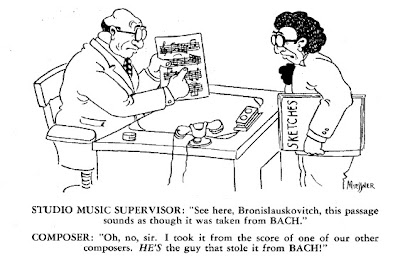 Image Source: The Score, 2.7-8 (1945) (PDF).
 Image Source: The Score, 2.7-8 (1945) (PDF).

Thursday, August 18, 2011
Marlin Skiles Says...

The American Society of Arrangers and Composers has posted PDFs to four volumes of The Score, the organization's newsletter, from the late 1940s. At the time, the organization claimed membership by the prominent orchestrators and arrangers working in Hollywood. The following, short article by composer and arranger Marlin Skiles is typical of the materials to be found in the newsletter
Among the subscribers to THE SCORE, there are undoubtedly many people who wonder just how the arranger functions in the music profession. Consequently, I think it would be well to give a description of just what the arranger's place is in musical society.
Most of our popular music is written for voice with piano accompaniment. As there are many mediums of performance other than vocal, it is necessary then to have this music transcribed, or re-written so that it is possible to perform it in another manner.
This is the arranger's job. Every time a piece of popular music is performed in any other version than that of voice and piano, an arrangement or orchestration has to be made for the particular way it is to be performed.
The arranging profession came to the fore with the advent of the jazz era, and it is a singularly unique American development. It is a definite expression of the American way of life, caused by the desire for individualism, variety and the demand for something new and different.
A competent arranger is expected to be, among other things, an excellent musician, a clever "idea" man, an inventor of new styles or patterns, and a composer of sorts. He is supposed to shun the thought of imitating any previously employed devices in his idiom.
This, of course, is quite an assignment, and it is remarkable that so many thousands of music writers in this country pass the test. The arranger has become as necessary to our present popular music production as the mouthpiece is to the wind player or the bow to the fiddler.
It can truthfully be said that without the arranger, easily 80 per cent of our popular songs would never have been written. This estimates the percentage of popular songwriters who cannot so much as write their own melodies.
Hence jazz itself would never have risen above the cacophonous state in which it was born, had not the arranger appeared on the scene.
Source: "Marlin Skiles Says," The Score 1.3 (March 1944), 1. (Link is to PDF.)
Image source: Color masthead was excerpted from the cover posted here.
Subscribe to:
Posts (Atom)

